A fleet manager with eleven box trucks asks what you would charge to clean them every other week, and somewhere in that conversation she mentions her own truck sits in the same yard.
You have washed ten thousand square feet of concrete this year without blinking. Now you are doing math on what a repaint costs, and the quote you send back is high enough that she does not take it.
That is the whole problem with vehicle work. It is not that contractors cannot do it. How to pressure wash a car without damaging paint feels like one question with one answer, so the only lever anybody reaches for is the pressure knob. Turn it down and hope.
There are three steps to washing a painted surface. Low pressure is only one of them, and it is the one doing the least. Here is what the other two do.
Step one: what is at the tip, and why pressure matters least
Start here because it is the one everybody gets wrong in the same direction.
The damage contractors picture when they think about vehicle work is almost never a machine that was too big. It is a tip that concentrated everything that machine had into a quarter inch of panel.
A 4 GPM unit through a wide fan at a sane distance is not going to lift paint. The same unit through a zero degree tip will cut a line through a decal in the time it takes you to realize what you are looking at.
The tip that stays on the gun
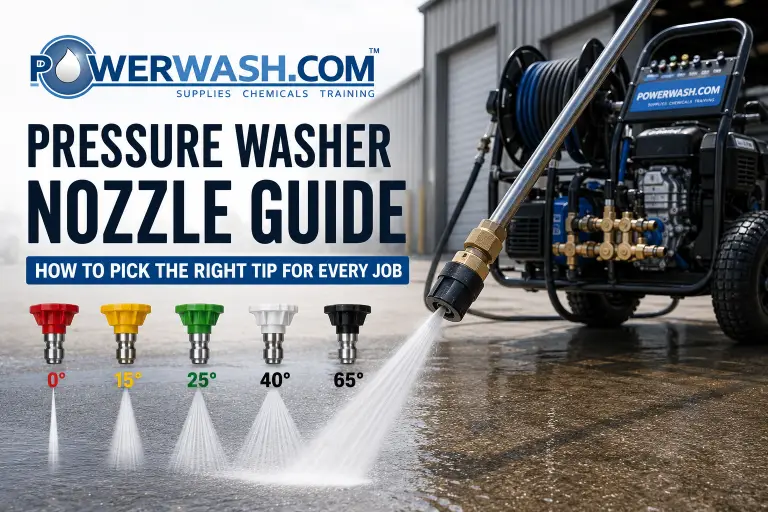
Our nozzle guide puts the vehicle tip plainly. The 40 degree white is the wide, gentle fan built for rinsing, windows, vehicles and delicate surfaces. That is the tip that stays on the gun for the whole panel.
The 25 degree green is the everyday flatwork tip. It belongs on concrete, not on a door.
Two tips that never touch a vehicle
- Zero degree red. Keep it off wood, siding, and anything a customer cares about.
- Turbo. This is the one that gets contractors in trouble, because it feels controllable in your hands. It should never go on wood, on siding, or anywhere near your customer’s new truck.
Lower panels and wheel wells are a fair argument for stepping down to a tighter fan, and plenty of pros do. Just make the decision at the tip, deliberately, on a specific part of the vehicle. Do not drift into it because the road film is not coming off fast enough.
Step two: how far back you stand
Pressure at the tip and pressure at the panel are two different numbers, and the thing that separates them is how far back you are standing.
Every foot you add drops the force on the surface and widens the pattern. That is why the same tip that is safe at four feet can mark at eight inches. Most contractors already know this. They just do not think of it as a step they are setting, so they never set it on purpose.
Set it on purpose! Pick your working distance before the first pass, hold it along the whole panel, and let the chemistry close the gap on anything that does not come off.
When road film is holding on, the instinct is to move in. Moving in is the single most common way a contractor marks a vehicle, and it is almost always a sign that step three was rushed.
Two places to be deliberate
- Edges and seams. Spray can get behind trim or a decal lip and lift it.
- Anything aftermarket. A wrap, a decal, a repaint on a quarter panel, a magnetic sign that has been baking on a door since July. You cannot see how well any of that is bonded, so it gets more distance than the factory finish beside it.
[CONFIRM: powerwash.com publishes no standoff distance, so this section teaches the principle rather than a number. If the team wants inches in the copy, it has to come from somebody with the gun in hand. See verification notes.]
Step three: what is in the water
Here is the part that makes vehicle work profitable instead of nerve wracking. If the chemistry is right, you never need high pressure.
Road film is a bonded layer, not loose dirt. It is diesel soot, brake dust, mineral from road spray and oxidation from a summer of UV.
No amount of water velocity is going to argue that off a panel. A soap that foams, clings and sits is what breaks the bond. The rinse just carries it away.
So the sequence on a painted vehicle is chemistry, dwell, low pressure rinse. Three things to get right inside that.
Pick a soap built for the finish
Pink Thunder is “formulated to be safe on both painted and unpainted surfaces,” and the page names cars, trucks, motorcycles, RVs and boats “without causing damage to delicate finishes.” Through a power washer it runs at half a pound to a gallon of water for the concentrate. From there it goes 10 to 1 up to 40 to 1, depending on how heavy the grime is.
R-111 Classic Brown is the other one worth knowing for car work. It is built to cling on vertical surfaces, which on a vehicle is most of them.
Make the foam do more
Cling is dwell time you do not have to stand around for.
R-1400 Super Foaming Booster goes in at 7 ounces per gallon of chemical cleaner, or 35 ounces per 5 gallons. It “increases foam and improves cling on vertical and hard to reach surfaces,” so the detergent works longer and penetrates deeper. It is compatible with both acid and alkaline detergents, which matters in a minute.
If you are applying through a downstream injector and watching your soap hit the hood and run straight off it, that is the gap a foamer closes.
Do not let it dry
The R-111 instructions say it straight. Wash in a shaded area, and do not let the solution dry on the vehicle surface. A soap that dries on a panel has stopped cleaning and started being a spotting problem you now have to solve.
In October this cuts both ways. The cold slows the chemistry down. But the low sun and the damp buy you more working time than a July afternoon ever did, so a fall vehicle wash is easier to run clean than a summer one.
Where the brush comes in, and where two step does not
Two things get left out of most vehicle washing advice, and they are the two that decide what the job actually looks like.
A brush is not cheating
Chemistry and a rinse will get you most of the way on a maintained vehicle. On road film that has been building since August, contact is what finishes it.
A soft brush on a soaped panel is gentler than closing the distance with a gun. It also does the one thing a wand cannot, which is shear the film off instead of pushing on it.
The order that works:
- Foam the panel and let it sit.
- Brush while it is still wet and slick.
- Rinse low pressure from the top down.
What wrecks paint here is a dirty brush, not a brush. Rinse it between vehicles, keep it off the ground, and never take the one you used on wheels anywhere near a door.
Two step is a fleet tool, not a car tool
Two step chemistry is the other conversation, and it is a real tool with a real limit.
A low pH presoak breaks down road minerals and oxidation. Then a high pH soap goes directly over it to cut the grease and carbon, and the whole point is that it works without scrubbing. That is how fleets get washed at volume.
But our own fleet guidance draws the line in one sentence: acid then alkaline two step systems “can be effective for severe soils but are not polish safe.”
Which means two step is a tool for commercial bodies and trailers. It is not the move for a customer’s personal vehicle sitting in the same yard.
What separates a car wash from a fleet contract
Washing one vehicle well is a skill. Washing forty on a schedule is a business, and the difference is mostly in what you set up once and never think about again.
Volume work lives on a repeatable chemical process rather than a careful one. That is why the fleet side runs two step with a selector valve on the gun instead of swapping products between trucks. The Delux two step gun is the purpose built version of that: a 48 inch lance, a chemical injector rated to 5 to 8 GPM at 4500 PSI, and a selector that flips between the acid step and the soap step without you breaking stride.
The rest of what separates them is unglamorous:
- Water. Where does it go on that lot.
- Access. What time can you be in the yard, because most fleets only sit still at night.
- Throughput. How many units can one person actually finish in an hour once you stop treating each one like a detail job.
And then there is the thing the fleet manager cares about, which is almost never the dirt. She is thinking about what a filthy truck says about her company at a delivery, and whether you are going to be there on the fourteenth like you said. Show up twice on schedule and the price conversation gets noticeably shorter.
Our fleet and vehicle wash detergents are where that process gets built, from the presoaks and truck soaps to aluminum brighteners for polished tanks and wheels.
One note on those, because it is where vehicle work goes wrong after the paint is already handled. Polished and coated aluminum can stain or haze under a strong acid or a heavy caustic. Use an aluminum safe formula and rinse completely.
Three steps, and only one of them costs you anything
A painted panel is not a risk. It is a surface that is more fragile than concrete, and in three steps you can clean it without touching that fragility.
Set the tip and leave it. Set your distance and hold it. Then spend your effort on the only step that actually does the cleaning, which is the chemistry, because that is the one that lets the other two stay gentle.
The math on this is better than most contractors assume, because the barrier is not a second machine. It is a tip you probably already own, a soap built for the finish, and something to make the foam hang on.
That is a small list against a customer who has eleven trucks and a standing need every other week, in the months when nobody is calling about their driveway.
We have been family owned since 1973, and the people answering the phone have run the gun on fleets.
Call 1-800-433-2113 and we will spec a vehicle setup around the rig you already own.