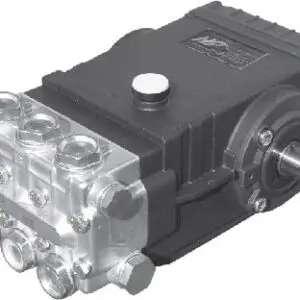
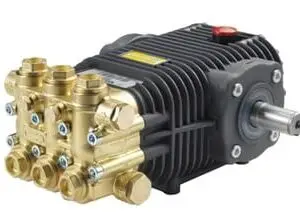
How to Choose a Replacement Pressure Washer Pump
Start with what your system supports
- Confirm the required performance: operating PSI and GPM for your cleaning tasks and downstream accessories.
- Verify drive style and speed: direct-drive vs. belt-drive, and the rated RPM of your engine or motor.
- Match the shaft and mount: hollow or solid shaft diameter, flange pattern, and orientation compatible with your power source.
- Assess water supply: municipal hose vs. buffer tank, hose length and size, and inlet filtration.
Insufficient inlet supply or excessive inlet restriction can cause cavitation and rapid pump damage. Use adequately sized feed plumbing, minimize suction lifts, and add a reservoir or inlet stabilizer when supply is marginal.
Compare common pump types
| Pump Type |
Common Use Cases |
Serviceability |
Notes |
| Wobble Plate |
Occasional, light-duty cleaning |
Often non-rebuildable; typically replaced as an assembly |
Compact, cost-focused; usually found on entry-level units |
| Axial Cam |
Homeowner to light commercial tasks |
Limited rebuild options depending on model |
Balanced performance for moderate duty cycles |
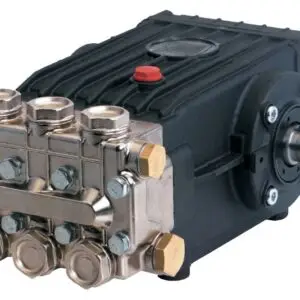
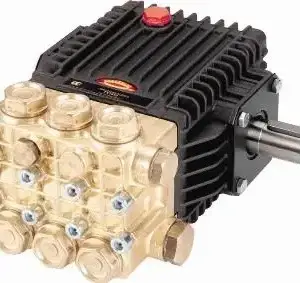
| Triplex Plunger |
Frequent or daily commercial/industrial work |
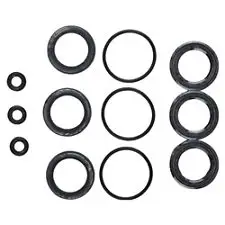
Designed for seal/valve service and full rebuilds |
Supports higher pressures/flows with smoother output |
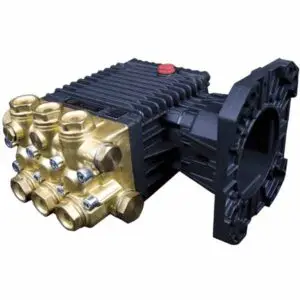
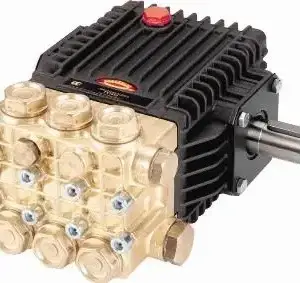
Triplex Belt-Drive
Uses pulleys to reduce pump RPM and isolate engine vibration. Favored for longer run times and stationary or fleet setups.
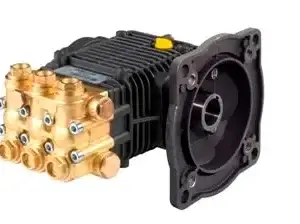
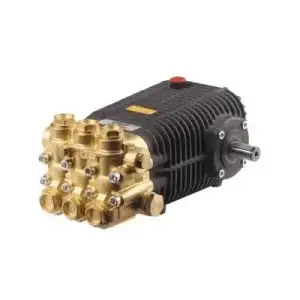
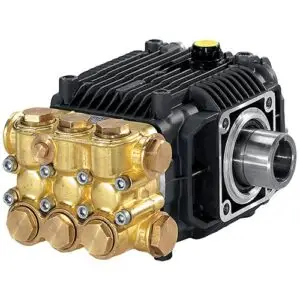
Triplex Direct-Drive
Bolts directly to the engine or motor for a compact footprint. Great for mobile rigs where size and cost matter.
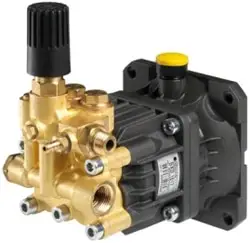
Axial Cam
Simple and compact with moderate output. A practical replacement when space and budget are priorities.
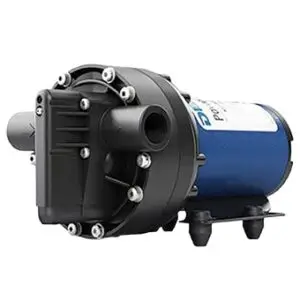
Wobble Plate
Entry-oriented design for occasional cleaning. When a wobble pump fails, replacement is more common than repair.
Match the shaft and mounting
Select a pump that physically mates to your power source and frame. Measure the shaft, confirm flange pattern, and check clearance for fittings and unloader plumbing.
3/4″ Hollow Shaft (Gas)
Common on small horizontal-shaft gasoline engines. Direct-couples with a gas engine flange.
1″ Hollow Shaft (Gas)
Used on higher-output engines. Provides room for larger flow/pressure ratings.
24 mm Solid Shaft
Typical for belt-drive, gearbox, or some electric motor couplings. Requires pulley, coupling, or gearbox hardware.
5/8″ Hollow Shaft (Electric, NEMA 56C)
Common on direct-coupled electric motor builds. Verify motor frame and bolt pattern.
Spec matching quick reference
| If you know… |
Then confirm… |
Why it matters |
| Target PSI & GPM |
Pump rating equal to or above both values |
Undersizing shortens life; oversizing can require more power than available |
| Engine/Motor RPM |
Direct-drive pump rated for that RPM, or pulley ratio for belt-drive |
Ensures rated performance and avoids overspeeding |
| Drive Type |
Direct-drive flange vs. belt-drive/gearbox mount |
Determines coupling hardware and layout |
| Water Source |
Inlet plumbing size/length and filtration |
Prevents starvation and cavitation damage |
| Chemical Needs |
Upstream/downstream injection and unloader style |
Keeps detergents where they belong and protects pump components |
| Port Thread Types |
Inlet/outlet thread standards on pump and accessories |
Avoids adapter surprises and leak points |
Before you order, read the data tag on your current pump and note model number, PSI, GPM, shaft size, drive type, and inlet/outlet port sizes. Matching these details minimizes retrofit time.
Need help confirming fitment?
Our team can verify shaft size, flange pattern, and performance requirements and recommend the best replacement pump for your setup.
Talk to an Equipment Specialist