
Surfactants for Pressure Washing
Surfactants reduce water’s surface tension so cleaners spread, lift soils, and rinse predictably. The right system can improve dwell time, coverage, and overall results without over‑foaming.
This category features surfactants and blends used in professional pressure and soft washing, including options compatible with sodium hypochlorite (bleach) and hard‑water conditions.
Use this guide to match surfactant types to common jobs, dial in mixing steps, and avoid compatibility pitfalls.
Brand
Price
- (1)
Product Grade
- (4)
- (4)
Showing all 6 resultsSorted by popularity
-
Sale!
-
-
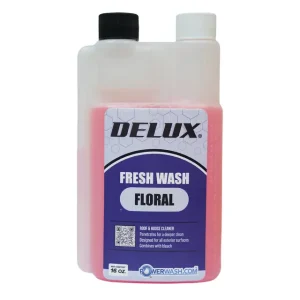
Fresh Wash Floral – Soft Wash Detergent
From $19.47 -
-
-
Surfactants for Pressure Washing: Selection and Use Guide
Surfactants are the wetting, foaming, and emulsifying engines inside many pressure and soft washing chemistries. The overviews below help you choose a surfactant system that supports your target soil, surface, and workflow.
Foam is not the same as cleaning power. Use surfactants to improve wetting, dwell, and rinsing—then pair with the right cleaner and technique for the job.
What surfactants do
- Lower surface tension so water spreads evenly and penetrates soils.
- Help lift and suspend oily soils for rinsing.
- Provide controlled foam and cling on vertical surfaces.
- Influence rinse speed, spotting, and residue.
Choose your surfactant system
Anionic surfactants
- Strong detergency and high foam; useful for general alkaline cleaning without oxidizers.
- May lose efficiency or form film/precipitate in hard water; pair with builders when needed.
- Common families include sulfonates and ether sulfates.
Nonionic surfactants
- Excellent wetting and emulsification with typically lower or tunable foam.
- Generally more tolerant of hard water; performance can vary around a product’s cloud point.
- Popular in degreasers and rinse‑aid roles.
Amphoteric surfactants
- Broad pH compatibility and good foam stability; often used to boost foam and mildness.
- Blend well with anionic or nonionic systems for balanced performance.
- Useful in many soft‑wash soaps when oxidizers are not present.
Bleach‑compatible blends (amine‑oxide based)
- Designed for sodium hypochlorite house‑wash mixes; enhance wetting, cling, and controlled foam.
- Selected amine oxides are noted for stability in hypochlorite and can aid viscosity for better dwell.
- Follow product labels for order‑of‑addition and dilution when combining with bleach.
Quick selector
| Application | Recommended approach | Equipment selection notes |
|---|---|---|
| Soft washing with sodium hypochlorite (vinyl, stucco, painted siding) | Bleach‑compatible surfactant blend (often amine‑oxide based) | Prioritize wetting and cling over heavy foam; rinse glass and exposed metals thoroughly. |
| Heavy grease and traffic film on concrete | Nonionic‑forward blend | Nonionics improve emulsification; pair with appropriate alkaline builder per product label. |
| Oxidized/chalky paint or pre‑paint prep | Anionic or amphoteric system in mild alkaline | Target soil release with controlled foam; avoid over‑application that can leave residue. |
| Final rinse aid / faster sheeting | Low‑foam nonionic | Use sparingly to reduce spotting; adjust if windows show filming. |
| Hard‑water areas | Nonionic or bleach‑compatible blends | Select hard‑water‑tolerant systems; consider builders or softened water when allowed. |
Mixing and use fundamentals
- Start with the manufacturer’s dilution on the product label; avoid guessing rates.
- Add surfactant to water (and bleach, if used) in the order specified by the product; add slowly with circulation.
- Test on a small, inconspicuous area before full application.
- Change only one variable at a time (dose, nozzle, dwell) when dialing in results.
- Excessive foam can reduce visibility and rinsing efficiency—back down the dose or switch to a lower‑foam option.
Troubleshooting
- Too much foam: Reduce surfactant dose or move to a lower‑foam nonionic blend.
- Poor wetting/beading: Increase dose slightly or choose a stronger wetting nonionic; verify the surface is free of sealers.
- Residue/filming: Rinse with more volume, use softer water, and avoid overdosing.
Safety and compatibility
Never mix sodium hypochlorite with acids or ammonia‑containing products. Wear appropriate PPE and follow each product’s label. Protect plants, finishes, and metals; rinse thoroughly.
Learn more
- Tailor Made Chemicals for Soft and Pressure Washing Jobs
- How to Find the Right Chemical for a Pressure Washing Job
- Learn How to Protect Plants and Shrubs When Soft Washing
Need help choosing a surfactant system?
Our team helps match surfactants to your equipment, water conditions, and target soils—so you get consistent, professional results.
Surfactants for Pressure Washing FAQ's
Can I mix bleach with acids, ammonia, or disinfectants?
No. Never mix sodium hypochlorite with acids or ammonia‑containing products. Only combine chemicals if the label explicitly permits it.
Are surfactants safe for plants and finishes?
Follow label directions, pre‑wet and post‑rinse plants, and avoid overdosing. Rinse glass and exposed metals thoroughly to reduce spotting or staining.
What should I do in hard‑water areas?
Choose hard‑water‑tolerant systems (often nonionic or bleach‑compatible blends) and consider builders or softened water when the label allows.
How much surfactant should I add to a house‑wash mix?
Always start with the product label’s dilution range. Adjust in small steps only if needed for coverage or foam control after a test patch.
Do surfactants increase cleaning power or just make foam?
They improve wetting and soil removal but are not a substitute for the right cleaner. Excess foam can slow rinsing—use only as much as needed for coverage and dwell.
Which surfactants are most compatible with sodium hypochlorite (bleach)?
Many bleach‑ready house‑wash blends rely on selected amine‑oxide surfactants. Always use a product labeled as compatible and follow its order‑of‑addition and dilution instructions.
What does a surfactant do in pressure washing?
It lowers water’s surface tension so cleaners spread, penetrate soils, and rinse more reliably. Depending on type, it can also add foam and cling on vertical surfaces.