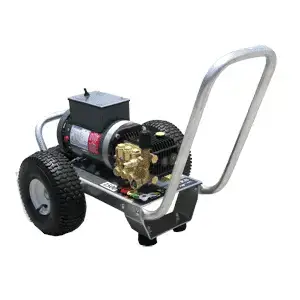
Electric Cold Water Pressure Washers: Selection & Buying Guide
Why choose electric cold water?
- Zero on‑site exhaust emissions and generally quieter operation than engine‑driven units.
- Preferred for indoor spaces or areas with limited ventilation and noise restrictions.
- Simpler upkeep (no fuel, spark plugs, or exhaust maintenance) and consistent torque from electric motors.
- Precise control with auto start/stop and wall‑mount or stationary configurations.
Plan power first. Verify voltage (120V, 208–240V, or 480V), phase (single or three‑phase), available amperage, plug type, and GFCI protection before selecting a unit.
Quick chooser: match power to the job
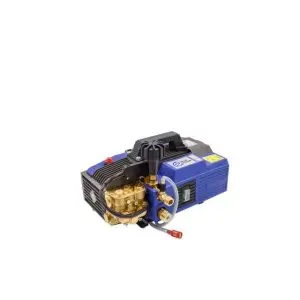
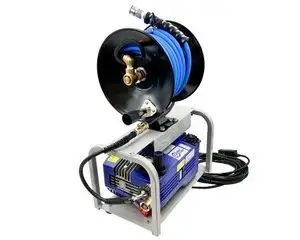
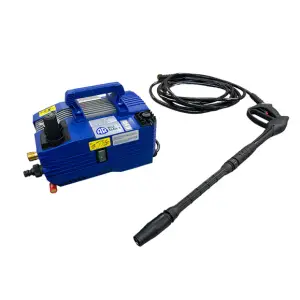
120V Portable (Light Duty)
- Best for small indoor areas, vehicles, tools, and light maintenance.
- Compact carts; easy to move and store.
- Typical output up to about 1500 PSI and ~2.0 GPM (model dependent).
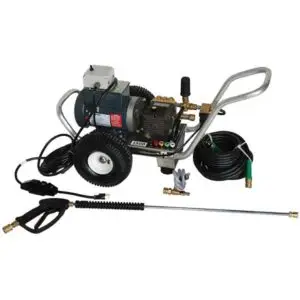
230V Single‑Phase (Medium Duty)
- Great for facilities, shops, and fleet bays needing faster rinse‑off.
- Often 2.5–3.2 GPM with ~2000–2500 PSI in portable or stationary frames.
- May require a dedicated 20–30A circuit depending on the model.
230/460V Three‑Phase (Professional)
- For production cleaning, equipment bays, and multi‑gun systems.
- Commonly ~4–5 GPM and up to ~3000 PSI; designed for longer duty cycles.
- Belt‑drive and triplex pumps favored for longevity and smoother flow.
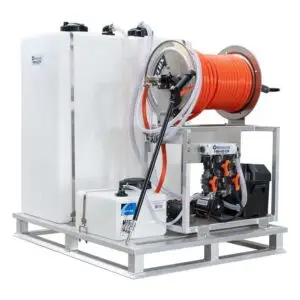
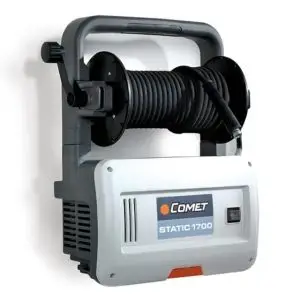
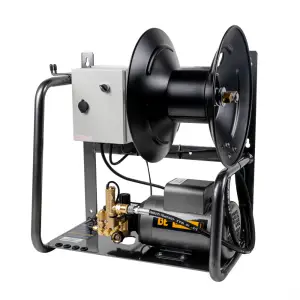
Stationary / Wall‑Mount
- Keeps hoses/guns at the point of use and the pump/motor off the floor.
- Supports auto start/stop and central chemical feed with return‑to‑tank plumbing.
- Match to facility power and intended hose lengths/runs.
Compare at a glance
| Use case |
Typical power |
Approx. performance range |
Notes |
| Detailing, small indoor areas |
120V, single‑phase |
Up to ~1500 PSI, ~2.0 GPM |
Fast setup; limited by 15–20A circuits and cord length rules. |
| Shops, fleet bays, food/retail back‑rooms |
230V, single‑phase |
~2000–2500 PSI, ~2.5–3.2 GPM |
Noticeably quicker rinse‑off; may be portable or wall‑mount. |
| Industrial wash areas, multi‑shift |
230/460V, three‑phase |
~3000 PSI, ~4–5 GPM |
Higher duty cycles; belt‑drive triplex pumps common. |
| Fixed indoor stations |
Match facility service |
Model‑specific |
Plan plumbing for bypass‑to‑tank and hose runs. |
Most cord‑and‑plug electric pressure washers require GFCI protection and may prohibit extension cords. Always install and use equipment per its labeling and manual. Confirm water supply, inlet filtration, and minimum hose ID to prevent pump starvation.
Equipment selection notes
- Pumps: Professional electric units typically use triplex plunger pumps for smoother flow and longer service life when maintained.
- Duty cycle: For frequent or multi‑gun use, consider three‑phase belt‑drive systems with adequate cooling and unloader bypass routed to a tank.
- Power quality: Verify available amperage, breaker type, and receptacle/plug match. Three‑phase units reduce inrush current per HP compared with single‑phase.
- Water: Many cold‑water units expect a pressurized supply. If drawing from a tank, match the pump’s inlet requirements and add a properly sized buffer tank and filtration.
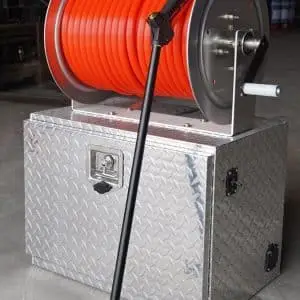
- Accessories: Size nozzles correctly, use non‑marking pressure hose of proper ID/length, and consider wall reels and lance options to speed workflows.
Learn more
Not sure which electric unit fits your power and workload?
Our team will match PSI/GPM, pump style, and electrical requirements to your site so you get reliable, indoor‑friendly cleaning without nuisance trips.
Talk to an Equipment Specialist