Most commercial power washing contractors know there are rules around wastewater. What fewer realize is how the enforcement landscape has shifted and how the contractors who understand it are using it to win accounts that price-only competitors can’t touch.
The regulatory framework
The Clean Water Act’s National Pollutant Discharge Elimination System (NPDES) is the governing framework for stormwater discharge from commercial cleaning operations. Most commercial exterior cleaning (fleet washing, building exteriors, food service pads, parking structures) technically requires discharge permitting.
Penalties for violations run up to $25,000 per day under the CWA. Multiple states have added their own per-day fines on top of federal exposure, and enforcement has become more consistent in recent years, not less.
Recent EPA updates to the Multi-Sector General Permit (MSGP) added PFAS monitoring requirements for certain discharge categories and tightened exceedance investigation standards. Contractors working near industrial surfaces, food-service equipment areas, or facilities with fire-suppression systems should understand how these rules apply to their jobs.
Hood cleaning: a specific watch area
Commercial kitchen exhaust cleaning contractors in several major markets are seeing more aggressive enforcement of NFPA-style “clean to bare metal” standards. Fire risk from inconsistent service schedules is a documented liability. Regulators in these markets are paying attention.
If you’re doing hood cleaning and your service intervals are loose, tighten them. Document every visit. That paper trail is both a compliance record and a sales asset, you can show a commercial client exactly how your service keeps them off a regulator’s radar.
Why this is a sales conversation, not just a compliance one
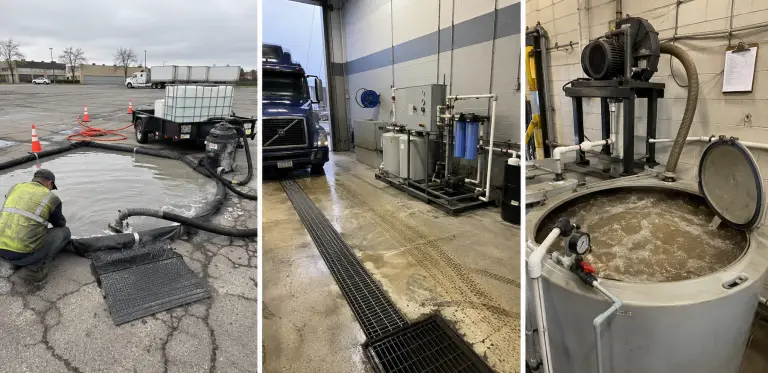
Here’s the shift that matters for contractors trying to build commercial accounts: wastewater capture gear (berms, drain mats, vacuum recovery systems) is increasingly mandatory on commercial work. The contractors who already have it built into their standard setup are showing up to bids with an answer that their competitors don’t have.
Think about the commercial buyer’s perspective. They’re managing a facility that could face five-figure daily fines for a discharge violation. They’re choosing between two contractors: one who shows up with capture gear and one who doesn’t. The one with the gear isn’t the same service at a different price; they’re a different category of contractor.
“We handle the wastewater, you won’t have a compliance problem” is a service layer that a box store equipped competitor simply can’t offer. It shifts the conversation from price to risk management. That’s a much easier sales conversation for a contractor who knows their stuff.
What to have in your setup
The baseline for most commercial work: a containment berm sized for the job, a drain mat or plug for any nearby catch basins, and a wet/dry vacuum or dedicated recovery system for the wastewater. On larger jobs or more regulated facilities, a standalone recovery and filtration unit is worth having.
The investment in capture gear pays back quickly when it becomes part of your commercial pitch. Most contractors who add it report that it changes how commercial buyers perceive them, and that perception difference closes accounts.
Compliance isn’t a burden that progressive contractors carry, and others avoid. It’s a line of differentiation that separates contractors who can serve commercial clients from those who can’t.
The contractors building durable commercial account bases right now are the ones leading with compliance. They know the rules, they have the gear, and they can explain to a commercial buyer exactly how they handle the regulatory side of the job.
Fifty years in the trade. Call us if you want to talk through the right capture setup for your specific jobs.