
Most contractors researching wash water recovery start with the wrong question. They ask what it costs. The better question is what kind of work you do, because that’s what determines which of these three systems is right for you.
There are three approaches in the field: mobile collection, permanent closed-loop recycling, and biological treatment. They’re not three price tiers of the same thing. They solve different problems.
Here’s what each system does.
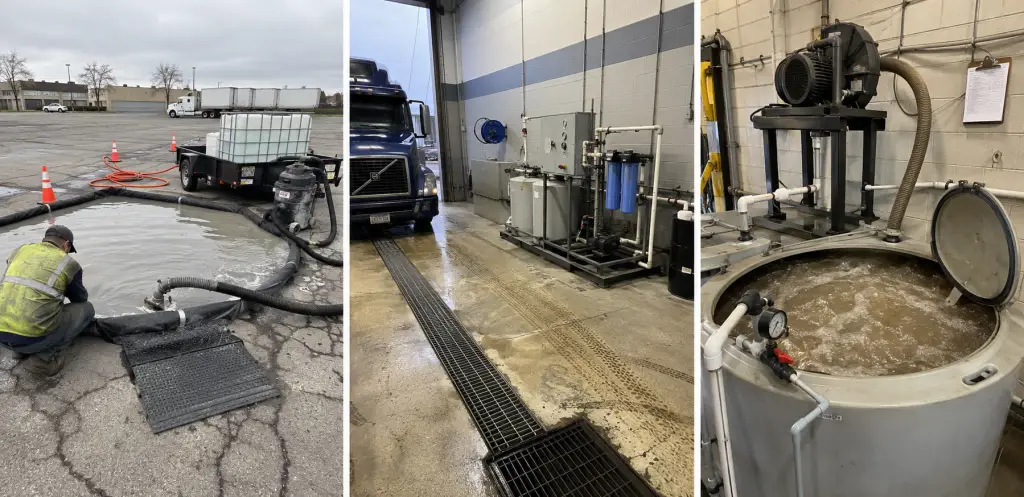
1. Mobile collection setups
A mobile setup captures wash water at the job site so it never reaches a storm drain and you dispose of it properly afterward.
A working setup usually includes:
- A containment berm or collapsible mat sized to the wash area
- Drain covers, mats, or plugs for any catch basin nearby
- A recovery tool: water claw, vacuum recovery surface cleaner, or vacuum boom along the low edge of the slope
- A vacuum source and a holding tank on your truck or trailer
- Basic filtration to keep debris out of your pump
From there, the water goes to an approved destination: a sanitary sewer connection if your local treatment authority has authorized the discharge, or a licensed hauler. Disposal of wash water is a local decision that varies by municipality. It is best to find out where to dispose of wash water before your job.
Where it fits: contractors who go to the work. Fleet washing, building exteriors, parking structures, food service pads, drive-thru lanes, gas station aprons. Anything where you’re on a different site every day.
The tradeoff: labor and capacity. Every job includes setup and teardown time, and your holding tank puts a limit on how much you can wash before you have to stop and dump the water. You’re also paying for disposal on an ongoing basis rather than paying once for equipment. When you price the job, make sure to factor in time and labor that go into water recovery.
The upside is that this is the cheapest to start of the three, and it’s the setup that turns a compliance requirement into something you can put on your bid sheet.
2. Permanent closed-loop recycling systems
A closed-loop system is a fixed installation at your wash station. Water runs off the pad, through the treatment, and back to the wash equipment to be used again. The same water gets cycled through your system.
The pad does a lot of the work. You will need sloped concrete, a trench drain or grated sump, and a collection pit. From there, the water moves through stages, roughly in this order:
- Solids removal — a settling pit, cyclone separator, or screen pulls out grit, sand, and debris
- Oil and water separation — a coalescing or gravity separator lifts free-floating hydrocarbons
- Filtration — bag or cartridge filters, then media filtration, often followed by activated carbon
- Odor and bacteria control — ozone injection or a chemical dose, because standing wash water goes anaerobic and starts to smell fast
- Clean tank and return pump — treated water goes back to the wash system
Done right, a closed-loop system reclaims the large majority of your wash water and cuts your freshwater draw to make-up volume only. On a high-volume pad, that changes your water bill in a way you can measure.
Where it fits: at a fixed location that receives a high volume of washing. Truck and equipment wash bays, municipal yards, transit and school bus depots, rental fleets, agricultural and construction equipment yards. Any operation washing the same kinds of things in the same place, day after day.
The tradeoff: capital, permitting, and maintenance. This is a construction project, not a simple purchase, so you will need to pour concrete, and depending on your jurisdiction, you may need plumbing permits and a sewer discharge authorization for the blowdown. It also isn’t truly closed forever. Dissolved solids concentrate with every cycle, so you periodically discharge a portion and add fresh water to keep the loop usable. Separator sludge and captured oil are regulated waste with their own handling and manifest requirements.
Nobody should sell you this system as maintenance-free. Filters will need to be changed, separators get pumped, and the whole system need to be checked regularly for any maintenance issues.
3. Biological treatment systems
This is the least common of the three, so it’s worth explaining how it actually works.
The technical version: a biological treatment system uses a living culture of bacteria, held in an aerated bioreactor, to digest the contaminants in your wash water instead of filtering them out mechanically. The microbes metabolize hydrocarbons, oils, greases, and surfactants, breaking them down into carbon dioxide and water.
The everyday version: it’s a tank of water with air bubbling through it and billions of bacteria living inside. Those bacteria eat the oil and soap in your wash water.
It’s the same biology that’s used in a septic tank, and the same thing your municipal treatment plant does in its aeration basins. This is a well understood process that is widely used at a large scale.
What makes it worth considering is where the contaminants end up. A mechanical system doesn’t actually get rid of anything; it pulls the oil and grit out of your water and concentrates them into filter cartridges, separator oil, and a tank of sludge, all of which you then pay a hauler to take away. A biological system consumes a real share of that load, so there’s less sludge to handle, less chemistry to dose, and less on the disposal invoice.
It also tends to smell better. Standing wash water eventually goes anaerobic, which means that the oxygen in it runs out and it starts to stink like rotten eggs. A bio system that’s running properly stays ahead of that, because the aeration keeps oxygen in the water and the bacteria eat the organics before they have time to rot.
One important limit: bacteria only eat things that came from living material. Oil, grease, diesel, soaps, and surfactants are all on the menu. Anything that was never alive, they ignore — metals, salt, dissolved solids, sand and grit, what the trade calls inorganics. That’s why a bio system doesn’t replace the mechanical stages, it sits behind them. Solids separation and oil/water separation go first to catch the grit and the free-floating oil, and the bioreactor handles what’s left dissolved in the water.
Where it fits: fixed installations with a steady, predictable, oil and grease heavy stream. Vehicle and heavy equipment wash bays, transit yards, shops with consistent daily throughput.
The tradeoff: you’ve stopped buying equipment and started keeping livestock. The culture is alive, and it needs what living things need. Three constraints to understand before you commit:
- Bleach and strong chemistry will knock it back or kill it. Sodium hypochlorite kills bacteria — that’s the entire reason it works as a sanitizer, and your bioreactor is full of bacteria. If you’re a soft wash contractor running SH, that water does not belong in a bio system. High-pH degreasers, solvents, and biocides cause the same problem.
- It has to keep eating. The colony needs steady flow, oxygen, and a workable temperature range. A pressure washer that sits idle for three weeks is fine. A bioreactor that sits idle for three weeks is a colony that’s been starving, and it can take days or weeks to build back up. A hard freeze or a shock load — a sudden slug of something far stronger or larger than the normal daily volume — does the same thing.
- It isn’t a complete system on its own. Biological treatment handles organics only. It won’t remove heavy metals, dissolved salts, or TDS, so it works as one stage in a treatment train, not as a replacement for the rest of it.
How to choose
Do you wash at your location, or the customer’s? If you travel to the work, you need mobile collection.
If you’re fixed, what’s your volume? Low or intermittent volume doesn’t justify a closed-loop build. Daily, high-volume washing does, and the water savings start doing real work on the payback.
If you’re fixed and high-volume, what’s in your water? Heavy oil, grease, and organics from vehicles and equipment is the case for biological treatment. Bleach, strong caustics, solvents, or a variable mix of chemistry is the case for staying mechanical.
And plenty of operations run more than one. A contractor with a shop wash bay and a mobile crew needs a fixed system for the bay and mobile collection for the trucks. Those aren’t competing purchases.
Wash water recovery is one of the clearest lines between contractors who can serve commercial clients and contractors who can’t. The equipment is the easy part of that. Knowing which system fits your work, and being able to explain to a facility manager exactly how you handle their wastewater, is what wins the account.
PowerWash.com has been helping contractors build and scale since 1973. If you’re weighing a recovery setup, call us and walk through your actual jobs with someone who’s specified these systems before. Fifty years in the trade — real contractors, real job decisions.