Gauges for Pressure Washers: Selection & Fitment Guide
What youll find in this category
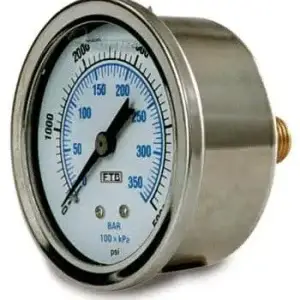
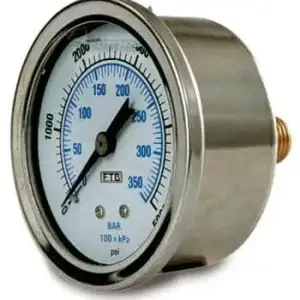
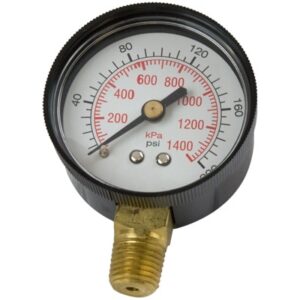
Shop pressure gauges built for pressure-washing and industrial cleaning. Options include dry and liquid-filled designs, bottom or back mounts, and common NPT connections for installing at the pump, manifold, or on a test hose. Use this guide to match range, connection, and construction to your setup.
For most daily checks, pick a gauge range where your normal operating pressure sits near the middle of the dial for easier reading and service life.
Popular gauge options
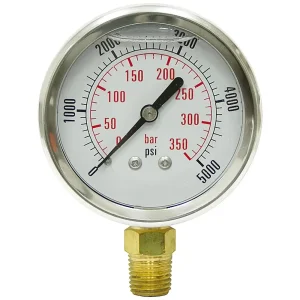
Liquid-Filled vs. Dry
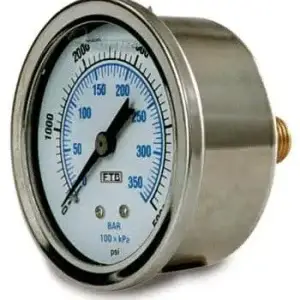
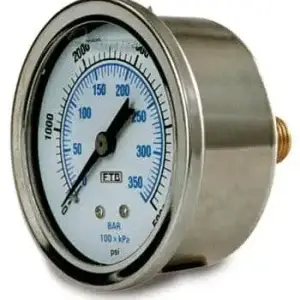
- Liquid-filled gauges help damp vibration and pointer flutter in high-pulsation wash systems.
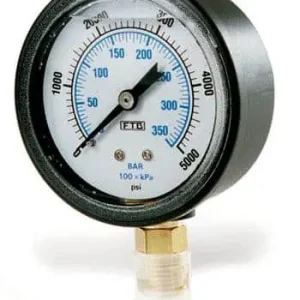
- Dry gauges are economical for stable, low-vibration locations or occasional test use.
Mounting & Connection
- Choose bottom or center-back mount to match your panel or inline adapter.
- Typical process connections are 1/4a0NPT or 1/2a0NPT; confirm thread size and gender before ordering.
Materials & Media
- Brass internals for water and general cleaning solutions.
- Stainless internals/case for harsher environments or when chemical resistance is a priority.
Protection & Accessories
- Snubbers/pulsation dampeners help protect the movement from rapid spikes.
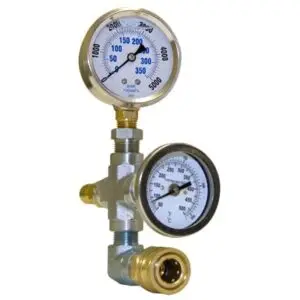
- Test tees/hoses make temporary checks easy without re-plumbing your machine.
Quick chooser
| Use case |
Suggested gauge type |
Notes |
| Daily system pressure check |
Liquid-filled, bottom mount |
Pick a range that centers normal pressure; add a snubber if pulsation is noticeable. |
| Panel-mounted readout |
Dry or liquid-filled, center-back mount |
Verify case size fits your panel opening and visibility needs. |
| Mobile service/test kit |
Compact dry gauge on test hose |
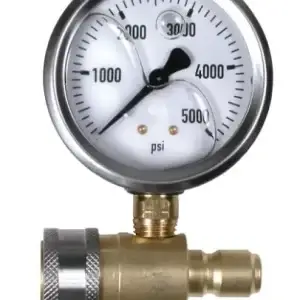
Use a tee or quick-couple adapter; choose a broad enough range for varied machines. |
| Harsh or wet environment |
Liquid-filled with stainless case |
Use protective boots or guards as needed; keep the lens clean for readability. |
Fitment tips
- Location: Install where the reading best represents system pressure (commonly near the pump outlet or on a test port).
- Threads: Confirm NPT size and seal with appropriate thread sealant; do not overtighten.
- Pulsation: If the pointer vibrates, add a snubber/dampener and verify the gauge is mounted rigidly.
- Liquid-filled venting: Some gauges include a vent plug; follow product instructions if venting is required after installation.
Never exceed the gauges maximum rated pressure. Overpressure can permanently damage the movement and create a safety hazard.
Equipment selection notes
- Choose a pressure range that keeps typical operating pressure away from the extreme low or high end of the scale.
- Use stainless wetted parts when chemical compatibility or corrosion resistance is a concern.
- For frequent pressure cycling, combine a liquid-filled gauge with a snubber for added protection.
- Back-mount gauges suit panel installations; bottom-mount gauges suit inline adapters and tees.
Care and troubleshooting
- Inspect the lens for cracks and moisture; replace damaged gauges promptly.
- Watch for slow or sticking pointersoften a sign of pulsation, clogging, or damage.
- Check for leaks at the connection after installation and recheck after first use.
- For critical accuracy needs, use a recently calibrated test gauge to verify readings.
Need help matching a gauge to your washer?
Our team can help you confirm the right range, mount, and connection for your machine and the accessories that protect it.
Talk to an Equipment Specialist