
Gas Residential Pressure Washers
Brand
Price
- (2)
Showing all 3 resultsSorted by popularity
-
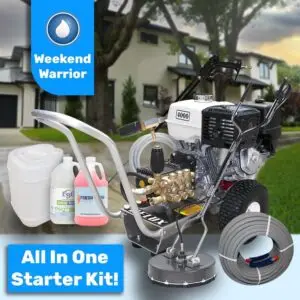
Weekend Warrior- Residential Cleaning House Washing Business Starting Pack
From $2,971.47
As low as $74.29/mo -
-
How to choose and use a gas residential pressure washer
Operate gasoline-powered pressure washers outdoors only. Exhaust contains carbon monoxide; keep engines far from doors, windows, and vents.
Why choose gas for home cleaning
Gas residential pressure washers offer strong cleaning performance and full mobility without relying on extension cords. They are well-suited for larger areas, stubborn grime, and routine projects like driveway cleaning, house siding rinses, and deck maintenance. Expect a bit more weight, noise, and routine care than electric models.
Match your cleaning goals
Driveways & Sidewalks
Pair your gas unit with a 25b0 nozzle or a surface cleaner to remove tire marks and track-in dirt quickly while helping reduce striping.
Decks & Fences
Use wider spray angles (25b02040b0) and keep the wand moving to help protect wood grain. Test in a small area first.
House Siding
Apply cleaner at low pressure and rinse from the top down. Avoid forcing water behind laps, soffits, or light fixtures.
Vehicles & Equipment
Use a 40b0 nozzle or foam accessory for pre-soak. Keep distance to protect paint, decals, and seals.
Equipment selection notes
- Flow (GPM) often determines how fast you can rinse; choose a balanced PSI/GPM combination that matches your surfaces.
- Confirm your garden-hose supply meets or exceeds the pump27s required flow; avoid kinks and long, restrictive hoses.
- Quick-connect tips are convenient; many homeowners rely on 25b0 and 40b0 for most tasks. Use narrower tips with care.
- Engines and pumps require periodic service; check oil, filters, o-rings, and hoses before each use.
- Consider a surface cleaner for large flat areas and a foam applicator for siding or vehicles to speed up dwell and rinse.
Gas vs. electric at a glance
| Attribute | Gas residential units | Electric residential units |
|---|---|---|
| Cleaning power potential | Higher potential for tough outdoor jobs | Good for light to medium tasks |
| Portability & reach | Unlimited by cords; bring hose & fuel | Limited by cord length and outlets |
| Setup | Fuel and oil checks before starting | Plug-in and go (GFCI recommended) |
| Routine care | Engine & pump maintenance required | Lower routine maintenance |
| Noise & vibration | Higher | Lower |
| Where to use | Outdoors only with ample airflow | Outdoors; some can be used in semi-enclosed spaces with adequate ventilation |
Select detergents labeled for pressure washers and surface type. Apply at low pressure, allow appropriate dwell time, and rinse thoroughly.
Setup & care checklist
- Before first start: add engine oil as directed and confirm pump is primed with water.
- Use a short, 5/822 or larger garden hose with full-flow fittings to prevent starvation and cavitation.
- Never run the pump without water; purge air from the hose before engaging the trigger.
- Match the nozzle to the task; begin with a wider tip and increase pressure only as needed.
- After use: relieve pressure, disconnect hoses, and store in a dry, frost-free area.
- Seasonal storage: stabilize fuel or run the tank dry, and protect the pump with a pump-saver product.
Learn more
Not sure which gas washer fits your home?
Tell us about your surfaces, water supply, and storage space. We27ll recommend a reliable gas unit with the right nozzles and accessories.