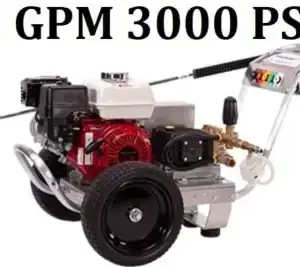
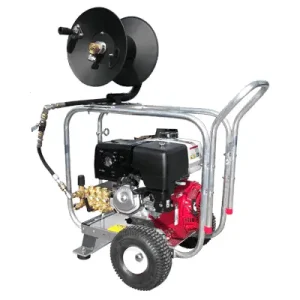
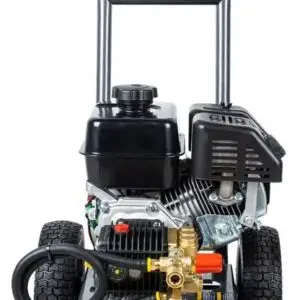
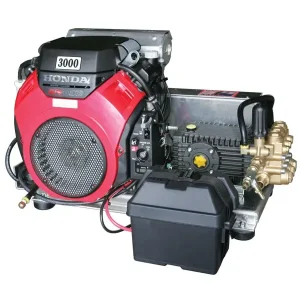
How to Choose a Portable Gas Pressure Washer
Why choose gas power?
- Go-anywhere cleaning where outlets aren’t available.
- Higher output options for faster rinsing and surface-cleaner work.
- Broad compatibility with pro accessories like rotary nozzles and surface cleaners (check each tool’s ratings).
Gasoline engines produce carbon monoxide. Operate outdoors only and keep engines well away from doors, windows, and vents. Never run a gas pressure washer in an enclosed space.
PSI, GPM and the work you do
Both pressure (PSI) and flow (GPM) matter. Use the ranges below as starting points, then confirm each model’s rating and your water supply capacity.
| Application |
Typical PSI |
Recommended GPM |
Notes |
| Decks and fences (softwoods) |
1,500–2,500 |
2.5–3.5 |
Use wider angles; test in a small area first. |
| General equipment and vehicles |
2,000–3,000 |
2.5–3.5 |
Rely on detergents; avoid concentrating pressure on paint/decals. |
| Concrete walkways and driveways |
3,000–4,000 |
3.0–4.0 |
Often paired with a compatible surface cleaner. |
| Heavy buildup, grease, or paint prep |
3,500–4,200 |
3.5–4.0 |
Use appropriate chemicals and, when needed, hot water equipment. |
Key build choices
Pump type
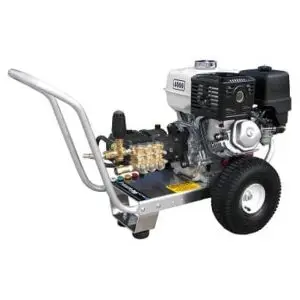
Axial-cam pumps are lighter and lower cost for intermittent use. Triplex plunger pumps are serviceable and commonly chosen for frequent or commercial use. If you expect long hours each week, a serviceable triplex is usually the better value over time.
Drive type
Direct-drive units are compact and economical for lighter-to-moderate duty. Belt-drive isolates heat and vibration to extend pump life in higher duty cycles; it adds size and weight.
Output class
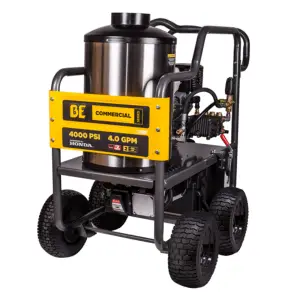
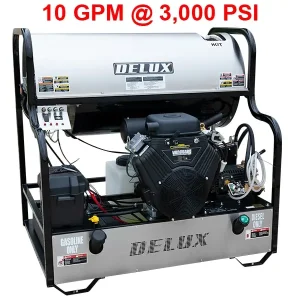
Prosumer: ~2.5–3.0 GPM at 2,800–3,300 PSI for mixed residential work. Commercial: ~3.0–4.0 GPM at 3,000–4,000+ PSI for faster concrete and prep work. Always verify ratings on the product page.
Portability details
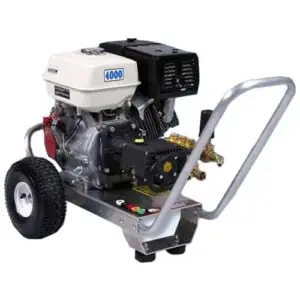
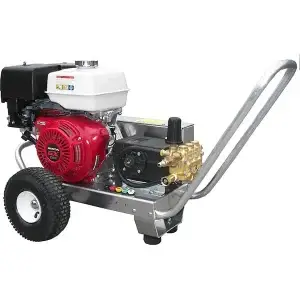
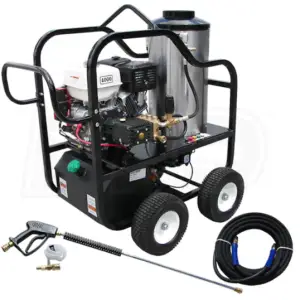
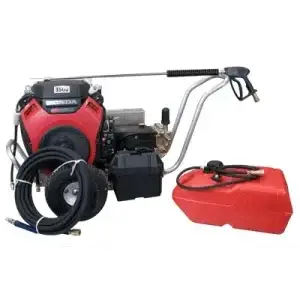
Look for a balanced cart, pneumatic tires, lift points, and hose/wand storage. Many gas portables list dry weights near or above 100 lb; plan loading and transport accordingly.
Water supply and accessories
- Match flow: a 4 GPM washer needs a steady 4+ GPM water source. A buffer tank can stabilize marginal supplies.
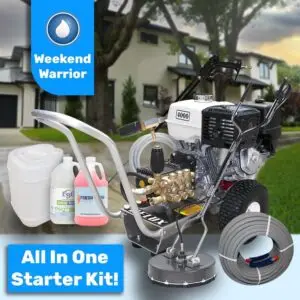
- Surface cleaners speed up flatwork—select a size your GPM can drive effectively.
- Nozzles: keep a full 0°, 15°, 25°, 40° and soap set; start wider and move narrower only as needed.
Maintenance checklist
- Follow the engine and pump manuals for oil types and change intervals.
- Flush detergents after each job and relieve pressure before storage.
- Inspect inlet screens, hoses, and fittings to prevent cavitation and leaks.
- Winterize before freezing weather to protect the pump and coils.
Choosing a serviceable triplex pump and matching GPM to your surface cleaner size are two of the biggest time-savers for routine concrete work.
Equipment Selection Notes
- Many commercial portable gas models are available in the 3.0–4.0 GPM and 3,000–4,000 PSI range for efficient flatwork.
- California models typically require CARB-compliant engines; confirm compliance on the product page if you operate in CA.
- Belt-drive builds are preferred for longer daily runtimes; direct drive suits lighter duty and compact transport needs.
Learn more
Need help sizing a portable gas unit?
Tell us about your water supply, run time, and surfaces. We’ll match PSI, GPM, pump, and drive to your workflow and budget.
Talk to an Equipment Specialist