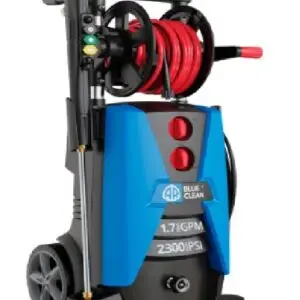
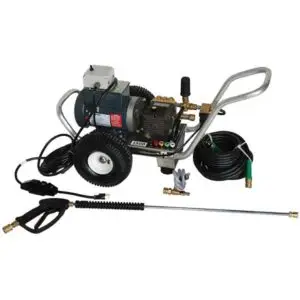
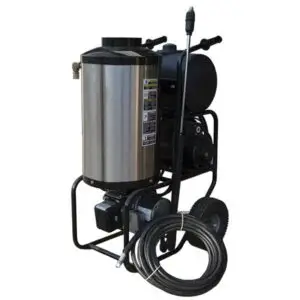
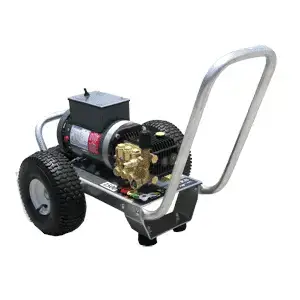
Portable Electric Pressure Washers: Buyer’s Guide
Why choose an electric portable
- Indoor‑friendly operation where engine exhaust is not acceptable and ventilation is limited.
- Lower routine maintenance compared to small gas engines.
- Quieter operation for neighborhoods, schools, healthcare, and hospitality.
- Instant start/stop convenience—no fuel storage or engine warmup.
Electric models are ideal when you have reliable power and want simple, low‑noise cleaning. Always verify electrical and water supply before use.
Selecting the right unit
- Flow (GPM) and Pressure (PSI): Match to the soils and surfaces you clean most. Higher GPM improves rinse speed; PSI helps with adhesion and crevice soils.
- Duty cycle: Look for commercial‑grade components if you run longer sessions or clean multiple days per week.
- Motor & pump: Induction motors and triplex pumps support heavier use; universal motors and axial‑cam pumps fit intermittent/light duty.
- Portability: Check total weight, handle design, wheel size, and hose/electrical management.
Quick cleanups & detailing
Great for vehicles, outdoor furniture, and small patios.
- Typically 120V, 15A
- Compact cart or hand‑carry frames
- Best with foam and soft‑wash tips
Residential & property care
Routine siding, walkways, decks, and equipment rinse‑downs.
- Often 120V, 20A (dedicated circuit recommended)
- Axial or triplex pumps, longer hoses
- Pairs well with a surface cleaner
Facilities & noise‑sensitive areas
Schools, hospitality, and light industrial spaces.
- Focus on quiet induction motors
- Non‑marking hose and compact storage
- GFCI protection is essential
Higher‑flow electric (where available)
When you need more rinsing speed from a portable footprint.
- Single‑phase 240V models
- Triplex pumps for longer duty cycles
- Confirm outlet type and circuit capacity
Power and water considerations
| Electrical class |
Typical performance range* |
Common use notes |
| 120V, 15A |
~1.0–1.5 GPM at ~1,000–1,800 PSI |
General light duty; verify shared loads on the circuit. |
| 120V, 20A |
~1.5–2.0 GPM at ~1,200–2,000 PSI |
Better for larger areas; a dedicated 20A circuit is often needed. |
| 240V, single‑phase |
~2.0–3.0+ GPM at ~1,500–2,500+ PSI |
Heavier use; ensure the correct receptacle is available on site. |
*Model‑specific ratings vary; always confirm the exact PSI, GPM, and amperage on the product page and nameplate.
Always connect to a GFCI‑protected outlet. Avoid undersized or coiled extension cords that can overheat. When a cord is unavoidable, follow the washer’s manual for maximum length and wire gauge.
Recommended accessories
Non‑marking pressure hose
50–100 ft lets you reach the work without moving the machine or resorting to long extension cords.
Foam cannon or injector
Match orifice size to your GPM for rich foam and faster dwell on vehicles and siding.
Surface cleaner
Choose a diameter sized to your flow (e.g., 12–16 in for ~1.5–2.0 GPM) to speed up flatwork.
Nozzle kit & inline filter
Keep a full set of tips and protect the pump from debris at the water inlet.
Keep it performing
- Use a water supply that meets or exceeds the pump’s GPM rating.
- Flush soaps and cleaners from the system after each job.
- Inspect and clean inlet screens; replace worn quick‑connects and o‑rings.
- Winterize before freezing conditions to prevent pump damage.
Not sure which portable electric washer fits your job?
Tell us about your power availability, run time, and cleaning goals. Our team will recommend the right PSI/GPM, motor and pump combination, and accessories.
Talk to an Equipment Specialist
Browse all Portable Pressure Washers